- IS09001 2015

Bevel Gear Manufacture
Straight and Spiral Bevels: Gear Manufacture
High-Precision Bevel Gear Production
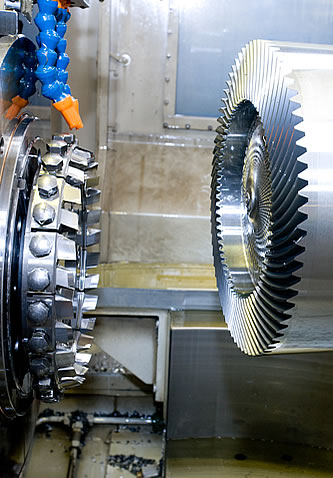
NTG manufactures both spiral bevel gears and straight bevel gears using advanced CNC gear cutting and grinding techniques. We utilise state-of-the-art manufacturing and finishing techniques for both gear types to optimise performance and quality. With capabilities up to 760mm diameter, 15Mod for spiral bevels and 250mm diameter, 7Mod for straight bevels, we deliver gears that meet the highest demands for accuracy, durability, and performance.
For applications requiring exceptional precision, we provide gear grinding after heat treatment, achieving superior tooth accuracy, geometry, and surface finish. Unlike spiral bevel gears, straight bevel gears do not allow us to grind teeth after heat treatment, which can impact the achievable precision. The ability to grind teeth on spiral bevel gears enables us to produce high-precision gears with reduced noise, vibration, and improved performance in high-speed, high-load applications. This ensures our bevel gears perform reliably in industries such as aerospace, automotive, marine, and heavy machinery.
Introduction to Bevel Gears
Bevel gears are specialised mechanical components designed to transmit power between two intersecting shafts, most commonly at a 90-degree angle. With a distinctive conical geometry, their teeth mesh together to change the direction of motion efficiently and smoothly. The conical shape of bevel gears allows them to function precisely when shafts intersect, as the pitch cones of the gears align at the point where the axes meet. Bevel gears are specifically designed for applications where shafts intersect at specific angles, enabling the transmission of mechanical power and allowing the gears to transmit motion between axes.
The versatility of bevel gears makes them a key component in a wide range of power transmission systems, from automotive differentials to aerospace engines and industrial gearboxes. Among the different types, spiral bevel gears are especially valued for their smooth, quiet operation and ability to handle high loads at speed. Conveyor systems are a common application where bevel gears are used to change the direction of rotational motion.
Types of Bevel Gears
Bevel gears are available in several designs, with each type of bevel gear (gear type) offering distinct features and applications:
- Straight Bevel Gears – The most traditional form, with straight teeth radiating outward. Commonly used in differential systems and machine tools for simple, reliable power transfer. The straight bevel gear is valued for its straightforward design and ease of manufacturing.
- Spiral Bevel Gears – Featuring curved teeth that engage gradually, spiral bevels operate more quietly and efficiently, especially in high-speed or heavy-duty applications. Spiral gears, as a category, are known for reduced noise and vibration, making them ideal for smooth power transmission.
- Zerol Bevel Gears – A hybrid between straight and spiral, with curved teeth set at a zero-degree angle for smoother engagement without increased thrust. The zerol gear is a specific form of bevel gear that combines the advantages of both straight and spiral designs.
- Hypoid Bevel Gears – With an offset gear axis, hypoid bevels transmit power between non-intersecting shafts, making them ideal for automotive axles.
- Mitre Gears – A specialised bevel gear with a 1:1 ratio, transmitting power at equal speed and torque between shafts. Mitre bevel gears are a specific type used primarily to change the direction of rotational motion at 90°.
- Internal Bevel Gears – Gears with teeth cut on the inside of the conical surface, used in compact or specialised gear systems.
Other related gear types include crown gear (used when the pitch angle is 90° and similar to a rack in spur gear systems), spur gear and spur gears (with straight teeth and used in parallel shaft applications), helical gear and helical gears (with angled teeth for smoother, quieter operation in industrial gearboxes), and other bevel gears (such as those found in planetary gear trains and differential systems), each offering unique advantages and applications compared to bevel gears.
This variety allows bevel gears to be tailored to diverse mechanical applications.
Bevel Gear Design
Designing a bevel gear requires careful calculation of multiple factors to ensure performance, efficiency, and durability.
- Gear ratio – Determines the relationship between driver and driven shaft speeds, based on the number of teeth on the driver and driven gears.
- Pitch cone and pitch angle – Critical geometry that defines how the teeth mesh; pitch angles influence the orientation of intersecting shafts and the overall gear geometry.
- Spiral angle – In spiral bevels, it determines smoothness of tooth engagement; spiral teeth with curved tooth lines and specific helix angles improve gear tooth contact, reduce noise, and enhance performance compared to straight bevel gears.
- Tooth geometry – Tooth shape (such as circular arc, involute, or trochoid), tooth depth, number of teeth, and the use of spiral teeth all impact gear performance, including strength, wear resistance, smoothness, and noise. The precise design of each gear tooth and the overall arrangement of gear teeth are crucial for optimal operation.
- Tooth contact pattern – Ensures power is distributed evenly across the surface, reducing wear. Proper gear tooth contact and well-designed gear teeth are essential for efficient load transfer and minimising vibration.
- Pitch surface, pressure angle, tooth line, helix angles, and shaft angle – The pitch surface is the imaginary conical surface where gear tooth measurements are defined. The pressure angle affects gear meshing and the smoothness of operation. The tooth line, which may be straight or curved depending on gear type, influences meshing and operating characteristics. Helix angles are present in spiral bevel gears, affecting tooth engagement and noise. Shaft angle determines the geometric relationship between intersecting shafts and impacts gear tooth contact and alignment.
- Material selection – High-strength steels, cast iron, or advanced alloys chosen depending on application requirements.
By optimising these design elements, our engineers deliver bevel gears tailored to each customer’s performance goals.
Bevel Gear Manufacturing Process
The production of bevel gears is a precise, multi-stage process:
- Design and simulation – CAD and analysis tools define the gear geometry and simulate performance under load.
- Material selection – Steels, cast irons, or alloys are chosen to suit the intended environment and stress conditions.
- Initial shaping – Methods include:
- CNC machining – highly accurate tooth cutting.
- Casting – cost-effective for large volumes or complex shapes.
- Powder metallurgy – for specialised applications.
- Gear cutting – Specialised cutters create the bevel profile.
- Heat treatment – Hardening, tempering, or case hardening for strength and durability.
- Gear grinding – For high-performance gears, grinding ensures precise tooth profiles, superior surface finish, and noise reduction.
- Quality assurance – Inspection of tooth geometry, runout, and profile ensures every gear meets international standards (AGMA, ISO, DIN).
A bevel gear set consists of a pinion and a gear working together to transmit mechanical energy between intersecting shafts. Bevel gear sets are manufactured for use in various machinery, including marine transmissions, where two bevel gear sets may be used in the power transfer system.
This process ensures bevel gears and bevel gear systems are produced with the accuracy, reliability, and finish required by critical industries.
Materials and Coatings
The performance of a bevel gear depends heavily on material selection and surface treatments:
- High-strength steels – provide durability and resistance to wear in high-stress environments.
- Cast iron – economical for many industrial applications.
- Brass and bronze – quieter operation and corrosion resistance for lighter-duty use.
- Powder metallurgy alloys – allow for specialised properties and compact gear systems.
To further enhance durability and performance, gears can be treated with coatings that protect against wear, fatigue, and corrosion, extending service life and reducing maintenance needs.
Applications of Bevel Gears
Bevel gears are used across industries where changes in shaft direction or torque transfer are required:
- Automotive – differentials, transmissions, and axle assemblies. In automotive differentials, bevel gears work with the ring gear and rear axle assembly to allow wheels to rotate at different speeds during turns. The hypoid gear and hypoid gear assembly are critical components, connecting the driveshaft to the ring gear and enabling the differential to function properly.
- Aerospace – high-precision power transmission systems.
- Marine – propulsion systems and auxiliary machinery. Bevel gears are used to transmit rotational motion efficiently within marine propulsion systems.
- Energy – power generation turbines and gearboxes.
- Industrial Machinery – conveyors, presses, heavy-duty gear drives, and printing presses. Zero-bevel gears are especially suitable for printing presses due to their smooth power transmission and quiet operation.
Their ability to handle high speeds and transmit significant power makes bevel gears indispensable in both precision and heavy-duty applications.
Get Started with NTG Bevel Gear Manufacture
If you require straight bevel gears or spiral bevel gears, NTG has the facilities, expertise, and proven track record to deliver precision-engineered solutions. From design and material selection through to heat treatment, grinding, and inspection, we ensure every bevel gear meets the highest standards of accuracy and durability.
Contact NTG today to discuss your project requirements and request a tailored quote.
Frequently Asked Questions
A bevel gear is a conical-shaped gear designed to transmit power between intersecting shafts, most often at right angles.
Straight bevel gears have straight teeth, featuring a straight tooth design and a straight tooth line, and are simpler in design but noisier under load. Spiral bevel gears feature curved teeth for smoother, quieter, and more efficient operation.
A Zerol bevel gear has curved teeth set at a zero-degree spiral angle, combining features of straight and spiral bevels for quiet, smooth power transfer.
Hypoid gears are used where shafts do not intersect, commonly found in automotive axles to provide smooth torque transfer.
They are produced using methods such as CNC machining, gear cutting, casting, and powder metallurgy. Precision grinding is often applied after heat treatment for high-performance applications.
Common materials include high-strength steels, cast iron, brass, bronze, and specialised alloys depending on performance requirements.
Gear grinding ensures superior accuracy, smoothness, and noise reduction, making it essential for aerospace, automotive, and other high-performance industries.
Yes. Spiral bevel gears, in particular, are designed for high-speed operation with reduced noise and vibration.
Industries include automotive, aerospace, marine, energy, and heavy machinery, all of which require efficient power transmission.
We can manufacture spiral bevel gears up to 760mm diameter, 15Mod, and straight bevel gears up to 250mm diameter, 7Mod.